Always Freezing Sweatshirt, Warm Cozy
A Designer’s First Look: Charm with a Hint of Caution
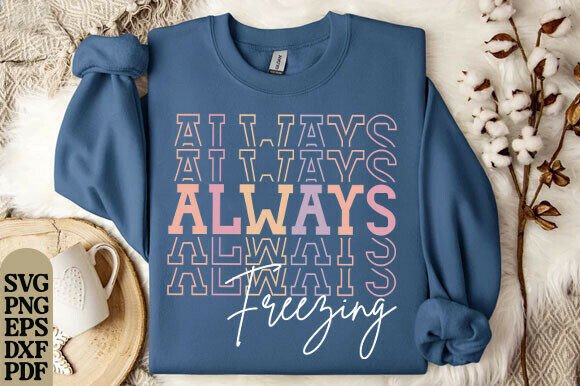
When I opened the Always Freezing Sweatshirt, Warm Cozy design bundle, my first impression was warm—but not in the way the title suggests. There’s an inviting, hand-drawn whimsy to it: soft rounded lettering, gentle curves, and a cozy, slightly imperfect rhythm that reads as handmade—not mass-produced. It lands somewhere between playful self-awareness and quiet comfort—ideal for someone who wears their “I need three layers indoors” truth like a badge of honor. As a designer who regularly selects embroidery files for client work and small-batch production, I immediately asked: *Does this translate cleanly from screen to stitch? And where does it earn its keep on real fabric?*
Where It Shines: Real Projects That Feel Authentic
I tested Always Freezing Sweatshirt, Warm Cozy on a medium-weight cotton-blend sweatshirt—same fabric most Etsy sellers and boutique shops use—and stitched it front-and-center on a custom embroidered tote bag for a local coffee roaster’s holiday gift set. The result? Instant recognition, light humor, and tactile warmth. Customers smiled before they even read the words—because the shape and spacing felt intentional, not cramped or overworked.
This design naturally fits best in low-to-moderate stitch density applications: sweatshirt embroidery (especially on relaxed-fit crewnecks), tote bag design, aprons for bakeries or craft studios, pillow covers for reading nooks, and baby embroidery on organic cotton onesies (paired with a simple heart or snowflake motif). Its friendly tone makes it strong for personalized gifts—think holiday embroidery for teachers, nurses, or new parents who truly *are* always freezing. For small shop product lines, it adds personality without shouting; it supports brand consistency when used alongside other minimalist, lifestyle-oriented design assets.
Where It Needs Thoughtful Handling
Don’t assume Always Freezing Sweatshirt, Warm Cozy will behave the same on every surface. On thin or stretchy fabric—like lightweight jersey tees or ribbed baby caps—the letterforms can blur if stabilizer isn’t chosen carefully. I ran a test on a curved cap front and found the bottom curve of the “g” in “Freezing” needed slight digitizing adjustment to avoid thread pull; out-of-the-box, it’s optimized for flat surfaces. Likewise, dense fill stitch areas (like thicker letter strokes) may require tear-away + cutaway stabilizer combo on textured fabrics like terry cloth towels or fleece blankets.
Small hoop sizes (under 4x4 inches) demand attention: the full phrase may need re-spacing or selective simplification—especially if you’re adding it to a pocket or baby bib. Tiny details (like subtle inner curves or fine serifs) won’t resolve well below 3.5" width in embroidery. And while the design works beautifully on light fabric, check contrast on darks: the original file doesn’t include reversed or knockout versions, so you’ll need to adjust thread colors manually in your embroidery software for optimal readability on navy or charcoal.
What This Means for Your Craft Business
As an Etsy seller or small shop owner, Always Freezing Sweatshirt, Warm Cozy is more than a graphic—it’s a conversation starter. When stitched cleanly, it boosts perceived value: customers associate thoughtful typography and balanced negative space with professional handmade product quality. But that perception hinges on execution. A poorly stabilized version on a stretchy fabric undermines trust faster than generic clipart ever could.
For commercial embroidery, remember: this is a digital embroidery file intended for physical output—not just print. Its strength lies in how it *feels* stitched: soft edges, breathable spacing, and legibility at arm’s length. That makes it ideal for boutique branding where authenticity matters more than flash. Just don’t expect it to double as an applique design or intricate satin-stitch monogram without modification.
Practical Designer Notes Before You Stitch
- Always test first: Run a sample on scrap fabric matching your final garment’s weight and stretch.
- Check thread color contrast: Especially on dark or heathered fabric—what reads clearly on screen may vanish mid-stitch.
- Review stitch density: If your machine hesitates or threads break on dense sections, reduce fill density by 5–10%.
- Confirm hoop size compatibility: Measure your design’s bounding box before loading—don’t force it into too small a hoop.
- Inspect small details: Zoom in on corners, curves, and letter junctions. Does the “z” in “Freezing” hold its shape? Does “Cozy” flow evenly?
- Test black-and-white mockups: Simulate how it reads without color—clarity should hold.
- Use proper stabilizer: Medium-weight cutaway for knits; tear-away for stable wovens like tea towels or canvas totes.
- Verify licensing: Since this is sold as a Graphics / T-Shirt Designs asset, confirm whether commercial use of finished embroidered products is permitted before listing on Etsy or wholesale channels.
Final Thought: A Design That Earns Its Place
Always Freezing Sweatshirt, Warm Cozy isn’t flashy—but it doesn’t need to be. In a market saturated with overdesigned slogans and pixel-perfect vectors, it stands out by feeling human-scaled and stitch-ready. It works because it respects the craft: it leaves room for thread texture, honors fabric behavior, and invites connection—not just decoration. Use it where warmth matters more than wow, where personality lives in proportion and pause, and where your customer sees themselves in the stitch—not just the statement.